A Singular Horizon I & II
2 digital prints

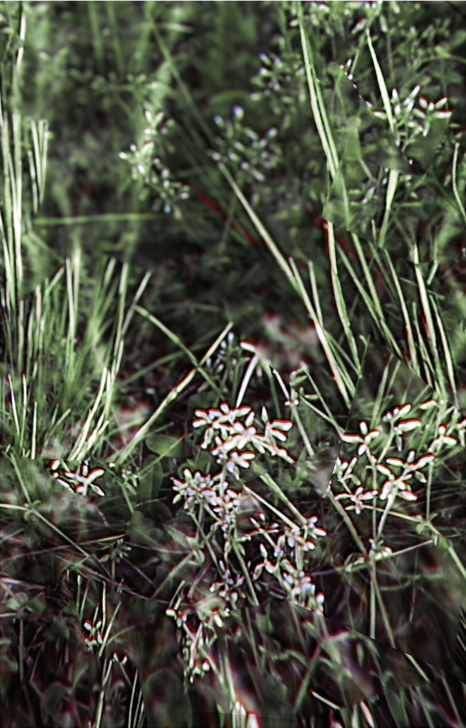
A pair of vertically oriented framed prints produced from digital renders of a photogrammetric model of a garden plot enclosed within an internal concrete courtyard
At first glance, the prints appear to depict coherent grass and scattered flowers. Closer inspection destabilises this apparent order: forms duplicate and misalign, areas blur, colours shift, chromatic aberration appears at the edges of details, and ghost artefacts emerge across the image field. Spatial orientation remains unstable and unresolved, with no stable horizon line, clear vanishing point, or dependable hierarchy between foreground and background.
The images have been produced by rendering a view of a digital of a garden plot enclosed within an internal concrete courtyard. This model was made using photogrammetry, a process of using measurements derived from photographs to reproduce physical objects digitally.
Usually the aim of photogrammetry is to recreate physical objects digitally with high accuracy. However, to produce these images a method of saturating the computational vision framework was used to make the digital reconstruction process unstable. The result was the production of a digital model of the garden plot that appears as distortion, but is the result of computational system applying its own logic under conditions that exceed it.
Growth within the garden plot is physically and chemically confined by the concrete surrounding it. The environmental conditions concrete create is a material-visual-epistemic claim that is mirrored by photogrammetry: that space is rational and divisible, and can be logically stabilised through devices such as the grid and the vanishing point or fixed horizon line.
The rendered images present the infrastructural assumptions embedded in the imaging process: that coherence can be enforced, that disorder can be stabilised, and that visibility secures truth. The collapse of the digital reconstruction functions as a method for interrogating the systemic logic shared by concrete infrastructure and photogrammetry. As both stabilise space through enclosure, repetition, and computational order, their coherence reaches a limit and appears as manufactured, strained, and contingent.
The resulting images stage this threshold as a horizon where order exhausts itself and becomes legible as contingent (not necessary or inevitable). The title names this threshold as singular, while the doubled sequence introduces a division that prevents closure.